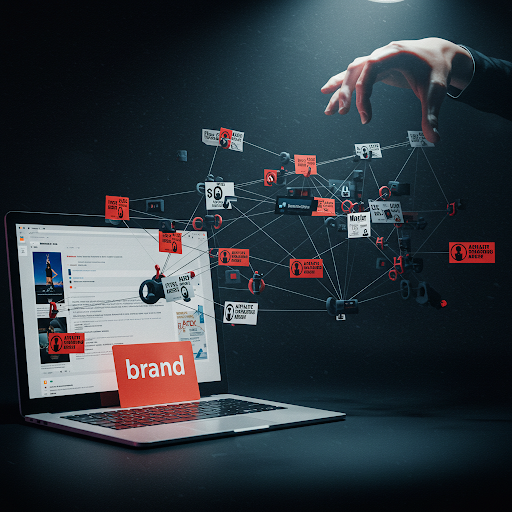
What is Abuse-Management-as-a-Service (AMaaS)?
Abuse-Management-as-a-Service is the commercialization of domain takedowns as an offensive weapon. It is emerging as a new layer in the cybercrime economy. And it’s worth understanding how it works, because the attack surface here isn’t a server or a database. It’s the process itself.
One of the critical avenues of open source intelligence is taking down malicious infrastructures such as domains, social media accounts, clusters of IPs. In our threat intelligence space, most organizations think domain takedowns happen only after legitimate abuse reports with proper evidence packaging. But threat actors on cybercrime forums have begun monetizing the takedown process itself, and that has the potential to be hazardous for all the wrong reasons. For instance, let’s imagine a set of cybercriminals mentioning paid takedown services only for the legitimate website or a competitor’s website to be under scrutiny, every time, as long as the monetization persists.
While this is just one example of DMCA abuse being commercialized on the forums, this blog explores what will happen if it actually starts scaling and how organizations– both large and medium scale can start observing early signals. Lastly, we review the mitigation measures to prevent being occupied from such attempts and focus on infrastructure strengthening by evaluating takedowns as an attack vector.
Key takeaways for security leadership:
A threat actor advertised a service processing 15,000+ abuse requests per day for hire, against any target
AMaaS exploits governance workflows, not technical vulnerabilities (traditional defenses don’t apply)
Smaller organizations face disproportionate risk due to limited escalation pathways
The attack succeeds even when every complaint is eventually dismissed, resulting in downtime and SEO loss happening first
Proactive registrar relationships and incident playbooks are the most effective defensive controls
The Threat Actor: What ‘clean_search’ Advertised
On 13 April 2026, a threat actor operating under the alias “clean_search” was observed advertising a range of domain and abuse-management related services on a popular cybercrime forum. The offering claimed the capability to process more than 15,000 abuse requests per day.
15,000+ abuse requests claimed per day
$100 entry price for mass phishing-abuse submissions
$1,000 expedited HOLD operations, certain registrars
8+ trusted organizations claimed as contacts
The advertised services included domain HOLD removal, delegation restoration, registrar communication, DMCA complaint filing, Google search result suppression, phishing-abuse handling, and dispute resolution involving hosting providers, CDNs, and domain zone regulators.
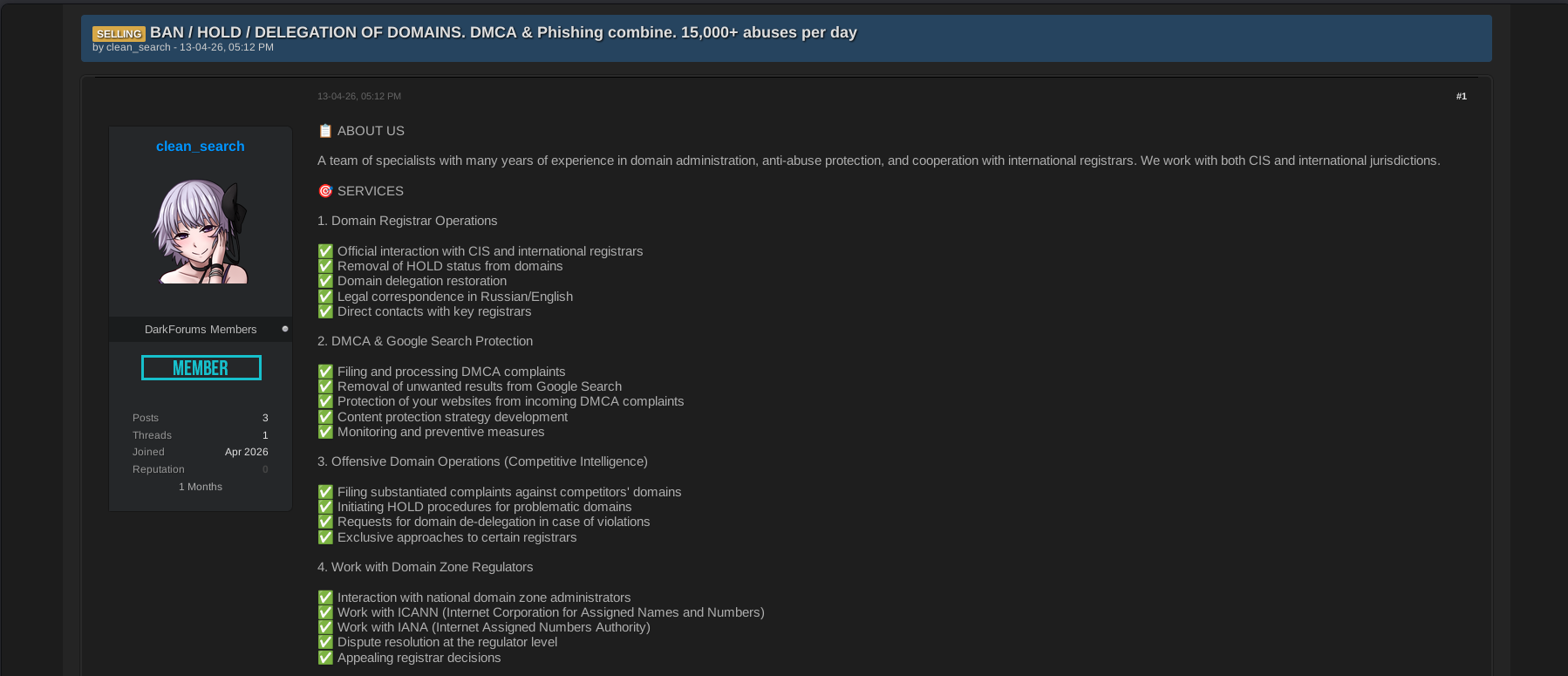
The advertisement also described offensive-oriented services, including filing complaints against competitor domains, initiating HOLD procedures, and requesting domain de-delegation. In addition, the actor claimed interaction with organizations and platforms such as ICANN, IANA, NetCraft, Cisco Talos, SpamHaus, APWG, Cloudflare, and Sucuri as part of abuse-resolution and anti-phishing workflows.
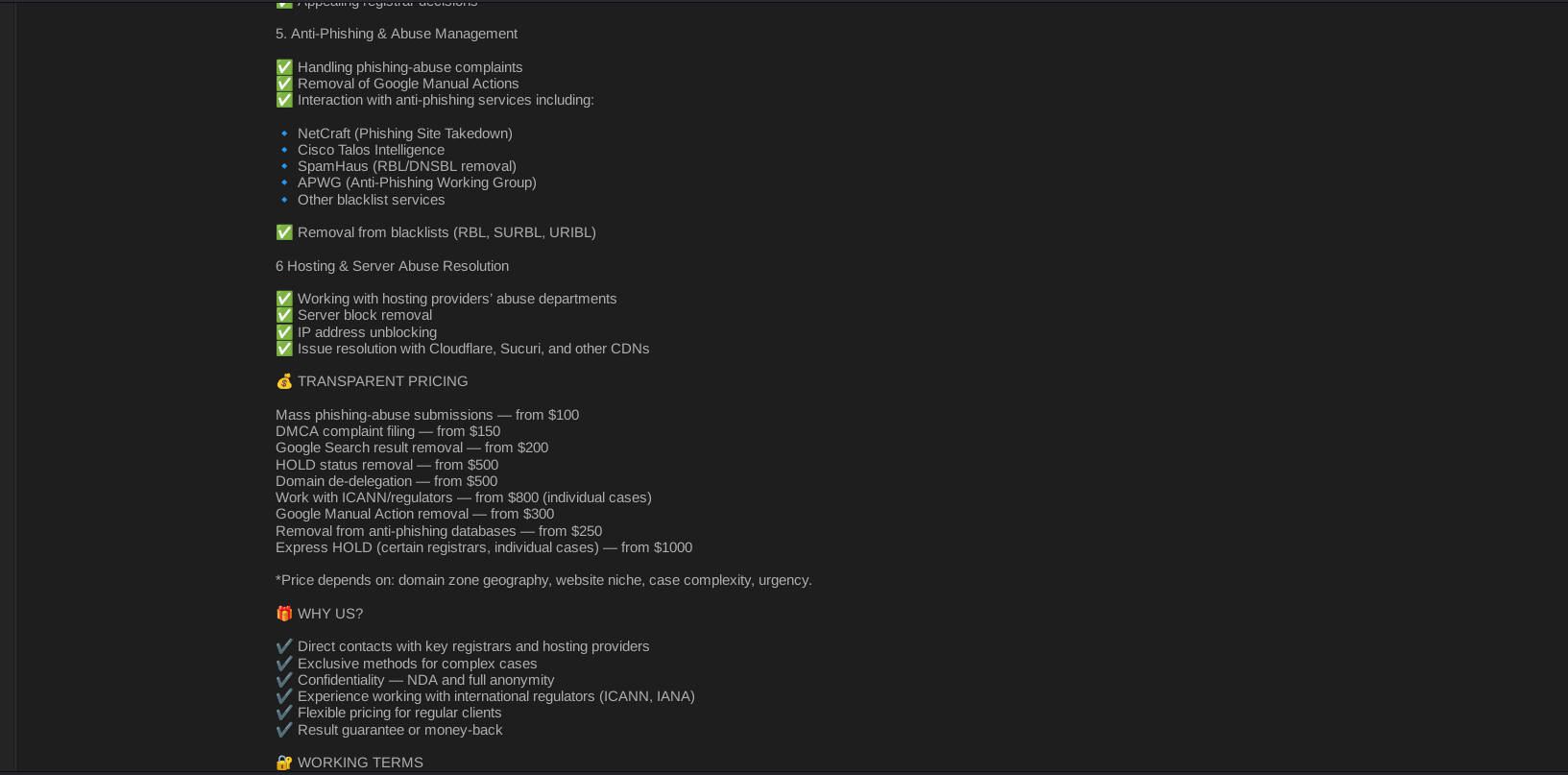
Pricing reportedly ranged from approximately $100 for mass phishing-abuse submissions to $1,000 for expedited HOLD operations involving certain registrars.

While confirming the legitimacy and operational effectiveness of these claims would be difficult, the offering reflects a growing trend where abuse-reporting and trust-and-safety workflows are increasingly being presented as scalable services within cybercriminal ecosystems.
How AMaaS Works Operationally
From a workflow perspective, the offering suggests something far more operational than a typical “takedown service.” Instead of directly compromising infrastructure, the advertised model appears to focus on manipulating the systems responsible for enforcing trust and safety across the internet.
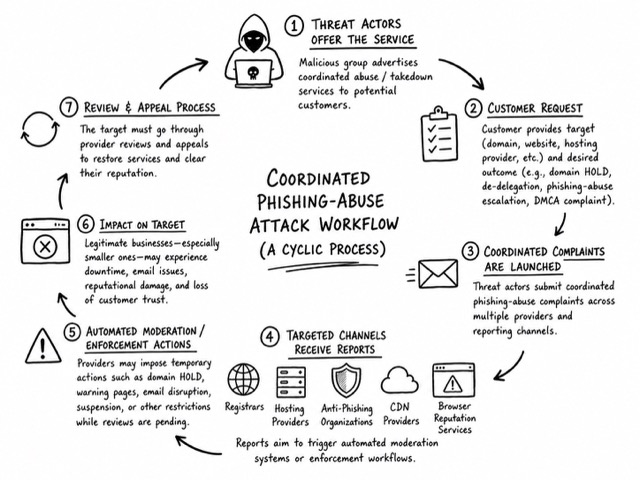
In a potential scenario, a customer approaches the service with a target: a domain, website, hosting provider, or online service alongside a desired outcome, such as a domain HOLD, de-delegation request, phishing-abuse escalation, or DMCA complaint. In exchange, the malicious service operators would then allegedly coordinate complaints across registrars, hosting providers, anti-phishing organizations, and abuse-reporting channels in an attempt to trigger moderation workflows or enforcement actions against the target.
Before moving on further, let us understand what happens in each service offered by the threat actor:
Domain HOLD / ClientHold Status: A domain HOLD, commonly referred to as a “clientHold” or registrar HOLD status, is an action where a registrar temporarily disables a domain’s ability to resolve on the internet.
Domain De-Delegation: De-delegation is a more severe process where a domain’s authoritative DNS relationship is disrupted or removed at the registry level. This process is generally reserved for serious policy violations, court orders, malicious infrastructure, or registry-level enforcement scenarios, leading to severe downtime.
DMCA Complaint Filing: DMCA complaint can request the removal of infringing material from websites, search engine indexes, hosting providers, or content distribution systems.
Interaction with Netcraft, Cisco Talos, Spamhaus, and APWG: These organizations play a major part in identifying malicious infrastructures on the internet and being classified by them can lead to suppressed email deliveries, browser warnings, blocked accesses and flags by other enterprises.
Google Search Suppression: If a domain is flagged through Google Safe Browsing, DMCA systems, or search-quality enforcement mechanisms, it may experience reduced search visibility, browser warnings, SEO degradation, or indexing restrictions.
PreCrime™ Labs Assessment
What makes this notable is not necessarily the existence of abuse reporting itself, but the scale and commercialization being advertised around it. Abuse-handling ecosystems across registrars, hosting providers, CDNs, and anti-phishing organizations are largely built around operational trust and finite reviewer capacity. If malicious actors begin mass-submitting coordinated complaints at scale, the result may introduce significant noise of false-positive enforcement actions into an already overloaded abuse queue(s). This can potentially delay responses to legitimate phishing or malware campaigns while simultaneously increasing operational pressure on analysts responsible for reviewing these reports.
Trust-and-safety workflows are increasingly being treated as an attack surface of their own. Cybercrime ecosystems have historically monetized infrastructure, malware, phishing kits, and access brokerage. Offerings like this suggest an evolution toward the commercialization of procedural pressure in cybersecurity, where governance and moderation systems themselves become tools for disruption, suppression, or competitive targeting.
Attack Scenarios and Business Impact
Use Case 1: False Phishing Reports Against Legitimate Businesses
A malicious customer could request the group to submit coordinated phishing-abuse complaints against a legitimate company’s domain or infrastructure. These reports may be sent to registrars, hosting providers, anti-phishing organizations, CDN providers, and browser reputation services.
The goal is to trigger automated moderation systems or temporary enforcement actions. Smaller businesses and startups may be particularly vulnerable if they lack direct escalation channels with providers, potentially resulting in temporary domain restrictions, warning pages, email disruption, or reputational damage while reviews are still pending.
Use Case 2: Competitive Suppression Through Domain HOLD Requests
A competitor or malicious actor could attempt to disrupt a rival’s online operations by generating large volumes of complaints designed to pressure registrars into investigating or restricting the domain.
Even if the complaints are eventually dismissed, the operational impact of temporary downtime, SEO loss, customer distrust, and support overhead can still be significant. The attack is profitable even when it fails.
Use Case 3: Abuse Queue Saturation and Delayed Threat Response
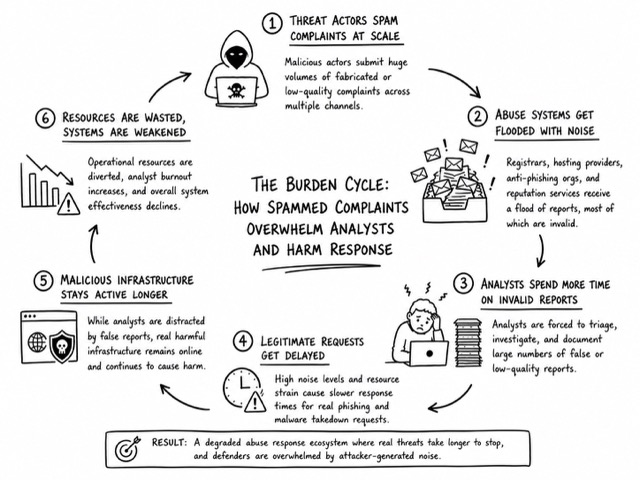
Large-scale complaint submissions introduce substantial noise into abuse-handling systems operated by registrars, hosting providers, and anti-phishing organizations. Analysts could be forced to process high volumes of fabricated or low-quality reports leading to increased delays in legitimate phishing and malware takedowns requests.
This creates a scenario where malicious infrastructure remains active for longer periods while operational resources are diverted toward false positives and fraudulent submissions.
Use Case 4: Retaliation Against Security Researchers or Threat Intelligence Firms
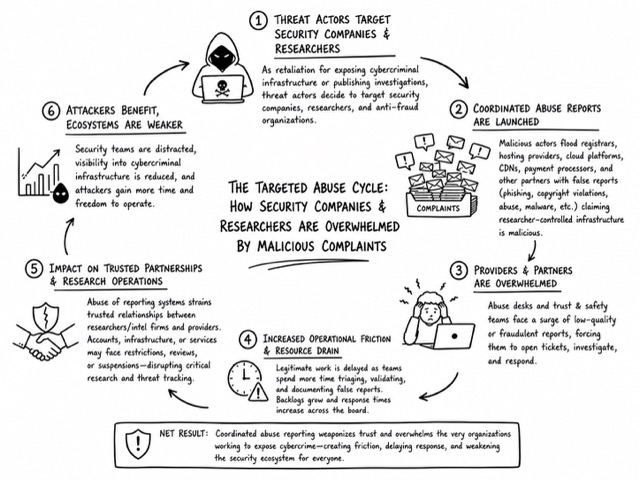
Threat intelligence companies, independent researchers, and anti-fraud organizations could become targets of coordinated abuse-reporting campaigns as retaliation for exposing cybercriminal infrastructure or publishing investigations.
Malicious actors might attempt to overwhelm providers with complaints alleging phishing, copyright violations, or abuse originating from researcher-controlled infrastructure. Such activity may increase operational friction and abuse of trusted partnerships between organizations actively tracking cybercrime ecosystems and providers.
Use Case 5: Infrastructure Pressure Against Hosting Providers and CDNs
Coordinated complaints directed toward hosting environments or CDN-backed services (providers such as Cloudflare, Sucuri) could be used to pressure providers into reviewing, restricting, or temporarily suspending customer infrastructure.
Even unsuccessful attempts can create operational disruption by forcing incident reviews, evaluations, and dispute handling.
Use Case 6: Procedural Denial-of-Service Against Trust-and-Safety Systems
Traditional attack vectors involve directly attacking the victim’s infrastructure through malware or DDoS activity, however, it has now shifted towards targeting the “process” with an intention to overwhelm operational workflows responsible for maintaining internet trust and safety.
By industrializing complaint submissions and moderation requests, malicious actors could create a stream of denial-of-service where the target is not a server, but the human and automated systems responsible for abuse handling, moderation, and governance.
Traditional Takedowns vs Industrialized Abuse Operations
Abuse reporting and takedown workflows were built for a different threat model: reactive, manual, case-driven. A legitimate victim, researcher, security vendor, or law enforcement entity identifying malicious infrastructure and submitting evidence-backed complaints for review. These reports were often limited in scale, highly contextual, and involved humans for request provision and validations. Analysts evaluated phishing indicators, malware behavior, copyright violations, or impersonation evidence before any enforcement actions or infrastructure takedown were initiated.
The emerging shift from isolated abuse reporting toward industrialized abuse operations suggests a scalable and automated workflow wherever applicable, generating large volumes of coordinated reports across multiple providers simultaneously. The actor’s claim of handling “15,000+ abuses per day” is associated with spam infrastructure, phishing campaigns, or bot-driven operations rather than traditional trust-and-safety reporting processes.
Mass complaint automation allows operators to repeatedly submit templated abuse reports and these submissions may be adapted across multiple languages, platforms, and reporting formats, enabling campaigns to target different providers operating across different pipelines.
This introduces the risk of queue saturation and operational fatigue within abuse-handling environments. A sudden increase in fabricated, forced, low-quality, or maliciously coordinated complaints can increase review latency, generate false positives, and divert analysts away from legitimate investigations. In practice, this creates a scenario where abuse queues themselves become targets for disruption.
The AMaaS model inverts every assumption that process was built on:
Dimension | Traditional model | AMaaS model |
|---|---|---|
Volume | Low, limited by human effort | 15,000+ per day, automated |
Evidence quality | High, evidence-backed, contextual | Fabricated or coordinated at scale |
Intent | Reactive, responds to confirmed threats | Proactive, targets of commercial choice |
Channel scope | Single provider interaction | Simultaneous multi-provider campaigns |
Language/format | Consistent, single-jurisdiction | Multilingual, multi-platform, templated |
Attacker expertise | N/A, defender-side | None required, fully outsourced |
PreCrime™ Predicts
The broader implication is that abuse-handling ecosystems may increasingly face the same problem through scaling and mass automating their operational workflows. Defenders, in such cases, may need to rethink how abuse reports are validated, prioritized, and correlated across platforms. Without stronger verification mechanisms, reputation scoring, and anomaly detection around complaint submissions, trust-and-safety systems become vulnerable not only to technical abuse, but also to operational exhaustion and manipulation at scale.
Business Risk Assessment: Who Gets Hurt? Smaller vs Bigger Organizations
High Risk: Small businesses, startups, independent operators
Limited or no escalation pathways with registrars and hosting providers. No dedicated security or legal personnel to navigate dispute workflows under live disruption. A single false-positive phishing report can cascade across multiple providers simultaneously, creating confusion and operational paralysis while the business has no roadmap for response. A small business temporarily losing access to its domain with registrar-level scrutiny may experience significant reputational and financial disruption even without security compromise taking place.
High Risk: Threat intelligence and security teams
Uniquely exposed to retaliatory campaigns. The more actively an organization tracks and exposes cybercriminal infrastructure, the more incentive threat actors have to weaponize AMaaS against it. Operational friction from coordinated complaints can reduce research output and damage trusted provider relationships built over years.
Medium Risk: Mid-market organizations
Mid-market organizations may have some security resources but lack the direct escalation relationships of large enterprises. Competitive suppression scenarios such as a well-funded competitor paying for HOLD campaigns, represent a realistic threat vector that current security programs are not designed to detect or respond to.
Lower Risk: Large Enterprises
The operational impact of large-scale abuse-report manipulation is unlikely to be distributed evenly across the different organizations. Larger enterprises often maintain dedicated legal teams, abuse-handling departments, trust-and-safety contacts, and direct escalation relationships with registrars, hosting providers, and operators. These organizations are typically better positioned to dispute fraudulent claims quickly, verify ownership of infrastructure, and escalate false-positive enforcement actions with minimal downtime. In many cases, they also maintain continuous monitoring over domain reputation, registrar status changes, DNS modifications, and abuse notifications, allowing them to detect suspicious activity early in the process.
The harm extends beyond traditional cybercrime discussions. The issue is no longer limited to malware delivery, phishing infrastructure, or technical compromise. Instead, it touches operational continuity, digital reputation, and access to online services themselves.
PreCrime Predicts: Potential Future Evolution
While the operational legitimacy and effectiveness of the advertised services remain difficult to independently verify, the model itself reflects a broader direction that trust-and-safety operations, and abuse-handling pipelines can potentially become an attack vector over time. Adding to it, the exploitation can span and scale across registrars, hosting providers, search engines, and anti-phishing organizations, making the automation of complaint generation increasingly attractive to malicious actors seeking operational leverage rather than technical compromise.
One potential evolution involves future campaigns that could potentially generate multilingual submissions tailored to different registrars, regional providers, or platform-specific reporting requirements. This may make malicious complaint campaigns more difficult to identify and attribute through traditional pattern matching alone, particularly if submissions appear linguistically unique while still targeting the same infrastructure or organization.
Another possibility is the emergence of bot-driven moderation pressure campaigns, where instead of targeting infrastructure directly through malware or denial-of-service activity, these campaigns would focus on overwhelming procedural workflows and increasing operational friction for the targeted organization. In practice, this could create persistent cycles of reviews, temporary restrictions, reputation flags, or escalation requests across multiple providers simultaneously.
The model also introduces the risk of competitive targeting, retaliatory reporting, or reputation-focused disruption against:
- Smaller businesses without dedicated security or legal resources
- Cybersecurity researchers actively exposing malicious infrastructure, investigative journalists and anti-fraud organizations
- Security vendors publishing threat intelligence
As cybercrime ecosystems evolve, the challenge may no longer be limited to detecting malicious infrastructure alone, but also distinguishing legitimate reports from coordinated moderation pressure campaigns designed to exploit the operational limits of internet governance systems.
Defensive Playbook for Security Leaders
For Registrars and Domain Providers
Registrars need to focus on strengthening complaint-validation workflows to reduce the impact of large-scale fraudulent submissions. This can include implementing reputation scoring for abuse reporters, identifying repeated complaint patterns, clustering similar submissions across campaigns, and introducing anomaly detection for unusually high reporting volumes targeting specific domains or customers.
Providers may also consider separating high-confidence threat reports from unverified submissions to reduce operational fatigue among abuse analysts.
Threat Intelligence and Security Teams
Threat intelligence teams should increasingly monitor abuse-report manipulation as part of broader infrastructure risk assessments. Organizations may benefit from tracking sudden registrar status changes, unexpected reputation flags, or spikes in complaint-related notifications. Maintaining historical evidence and tracking the development of such threats from underground forum discussions can help reduce operational impact and benefit providers as well as victims from being targeted.
Smaller Organizations and Independent Operators
Smaller organizations, researchers, startups, and independent platforms are likely to face unfair risk due to limited escalation pathways and visibility into registrar-level reachouts. Organizations may benefit from maintaining backup communication channels, preserving infrastructure ownership documentation, and establishing clear escalation procedures with registrars and hosting providers before incidents occur. Even temporary disruptions caused by fraudulent complaints can create reputational and operational challenges if rapid response mechanisms are not already in place.
Conclusion: The Emergence of the “Abuse Economy”
Cybercrime ecosystems have been historically evolving by targeting different attack vectors across the varying internet facilities. Early threat actors often handled infrastructure for malware development, phishing delivery, monetization, and operational security independently. Over time, they evolved to the emergence of models such as malware-as-a-service (MaaS), phishing-as-a-service (PhaaS), ransomware-as-a-service (RaaS), bulletproof hosting, and initial-access brokerage, allowing threat actors to scale operations more efficiently.
The emergence of targeting abuse-management and takedown-related services suggests a potential expansion by the threat actors to monetize from the processes over direct compromise.
Abuse-management-as-a-service (AMaaS) follows the same pattern – but the surface being monetized isn’t infrastructure. It’s governance. Abuse-oriented services focus on manipulating the systems responsible for restricting, moderating, and maintaining trust across the internet.
This matters to security leaders because the defensive playbook doesn’t transfer. In this novel model, governance ecosystems become an operational playground. Processes such as domain HOLD, phishing-abuse queues, DMCA systems, search visibility enforcement, and reputation scoring mechanisms are no longer viewed purely as defensive safeguards, but as potential levers for disruption, suppression, or competitive pressure.
PreCrime™ Predicts
If this trend continues, abuse-management-as-a-service may become another layer within broader cybercrime campaigns, sitting alongside phishing kits, malware loaders, and credential marketplaces.
FAQ
What is Abuse-Management-as-a-Service (AMaaS)?
AMaaS is a cybercrime offering where threat actors sell coordinated, mass-volume abuse report submissions targeting legitimate businesses, researchers, or competitors – designed to trigger domain suspensions, DMCA removals, or phishing flags through official internet governance channels. It exploits trust-and-safety systems rather than technical vulnerabilities.
How is AMaaS different from a DDoS attack?
A DDoS targets servers with traffic. AMaaS targets human and automated review systems with fabricated complaints, exploiting governance processes and finite analyst capacity rather than network infrastructure. Traditional DDoS defenses offer no protection against it.
Can a fake phishing report actually take down a legitimate website?
Potentially yes. Coordinated reports to registrars, CDN providers, and browser reputation services can trigger temporary enforcement actions, especially against smaller organizations with no direct escalation contacts. The damage occurs during the review period even when complaints are eventually dismissed.
Who is most at risk from AMaaS campaigns?
Small businesses, startups, independent researchers, and security vendors without dedicated legal or trust-and-safety teams face the highest risk due to limited escalation pathways and lower visibility into registrar-level actions.
What is a domain HOLD and how does it affect a business?
A domain HOLD (ClientHold) is a registrar action that temporarily disables a domain’s ability to resolve on the internet. Websites, email, and any dependent services stop working. It can be triggered by abuse complaints and requires a dispute process to reverse – a process that can take hours to days.
What should CISOs do to protect against AMaaS attacks?
Pre-register escalation contacts with your registrar and hosting provider, maintain accurate WHOIS records, document infrastructure ownership, monitor for unexpected domain status changes, and build an abuse-response incident playbook before an incident occurs.
Is AMaaS the same as a DMCA abuse attack?
DMCA abuse is one component of AMaaS, but AMaaS is broader. It coordinates pressure across registrars, CDN providers, anti-phishing organizations, browser reputation services, and search engines simultaneously, making it significantly more disruptive than a single DMCA complaint campaign.